Gas Line Repair & Inspection in Rockaway Park, Queens
Natural gas powers the heating boilers, water heaters, and cooking ranges that keep Rockaway Park residences comfortable. Gas piping systems exposed to humid ocean air, coastal corrosion, and cellar dampness require careful diagnostic pressure testing, precision pipe joint repairs, appliance shutoff installations, and strict adherence to NYC Department of Buildings fuel gas mandates.
Gas Piping Maintenance & Coastal Corrosion in Rockaway Park
In Rockaway Park and Belle Harbor, residential properties frequently feature black iron gas piping routed through damp sub-grade cellars, utility vaults, or exterior meter bays. The relentless presence of airborne marine salt combined with coastal storm dampness accelerates atmospheric oxidation. Over decades, unpainted iron pipe fittings, threaded elbows, and union couplings can experience pitting corrosion, compromising metal thickness and joint integrity.
Proper routine gas maintenance ensures that meter manifolds, sediment drip legs, individual appliance isolation shutoff cocks, and boiler manifold regulators remain tight, properly supported, and fully compliant with New York City building and fuel gas codes.
Whether you are replacing an aged steam boiler, connecting a high-efficiency gas water heater, or rectifying a utility violation tag, gas line work requires careful pressure integrity testing and licensed mechanical execution.
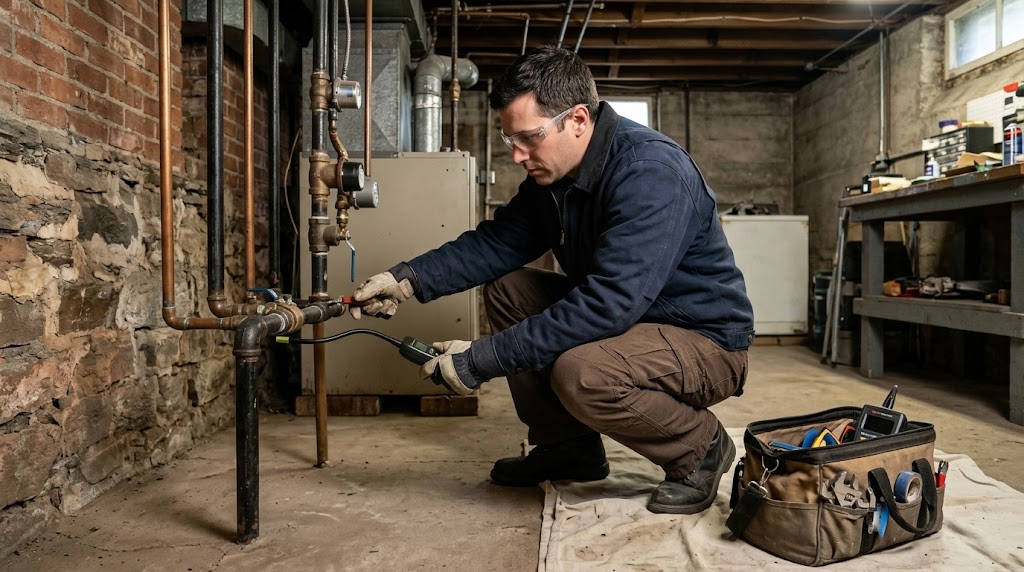
Precision gas piping inspection: calibrating gas manifold regulators, testing threaded iron fittings, and verifying manual shutoff ball valves.
NYC Local Law 152: Periodic Gas Piping Inspections
Understanding mandatory compliance requirements for Queens property owners.
Who Is Covered by Local Law 152?
Enacted to enhance building safety throughout New York City, Local Law 152 of 2016 mandates periodic inspections of exposed gas piping systems in all buildings, with the exception of one- and two-family private homes classified as R-3 occupancy.
If your Rockaway Park property is a three-family dwelling, apartment building, mixed-use commercial space, or condominium, it falls under the mandatory inspection cycle established by the NYC Department of Buildings (DOB) for Queens Community District 14.
The Inspection Process & Certification
Inspections must be conducted by or under the direct supervision of a Licensed Master Plumber (LMP). The inspection surveys all exposed gas lines from the point of utility entry up to public hallways and boiler mechanical rooms.
The inspector inspects for gas leaks using calibrated electronic sniffer devices, checks for illegal branches or unapproved flexible connectors, assesses severe pipe corrosion, and submits official GPS2 inspection reports to the DOB. Any identified non-hazardous conditions must be rectified within specified statutory correction windows.
Routine Gas Services for Rockaway Residences
Professional diagnostic testing, code correction, and appliance piping connections.
Boiler Gas Train Upgrades
Aged atmospheric boilers require modern gas trains including electronic intermittent ignition valves, redundant 24V safety solenoids, high/low gas pressure switches, and clean sediment dirt pockets.
Appliance Gas Line Installation
Extending dedicated black steel gas supply lines for commercial ranges, tankless water heaters, and laundry dryers with dedicated quarter-turn ball valves and CSA-approved stainless steel flex connectors.
Piping Pressure Integrity Testing
When gas service has been locked or shut off by the utility following a leak investigation, we isolate sections, apply calibrated mercury or digital manometer air pressure tests, and verify 100% leak-free integrity.
Utility Violation Clearing
If National Grid has issued a “red tag” or “A-tag” notice due to outdated brass valves, unvented regulators, or corroded cellar lines, we rebuild affected sections to satisfy utility re-activation standards.
Corrosion Remediation
Surface rust on coastal Rockaway gas pipes is mechanically cleaned, inspected for structural wall thickness, and coated with protective industrial rust-inhibitive enamel paint to halt oceanic salt degradation.
DOB Permitting & Sign-Offs
All substantial gas piping modifications require NYC Department of Buildings work permits and official gas sign-off documentation, ensuring full municipal compliance and insurance validity.
Related Heating & Combustion Services
Coordinated mechanical services for residential systems in Rockaway Park and Belle Harbor.
Boiler Replacement
Replace aging heating equipment with correctly sized gas-fired steam or hydronic boilers engineered for coastal longevity.
Explore Boiler Replacement →Water Heater Repair
Diagnose gas control valves, thermocouples, burner assemblies, and leaking tanks on atmospheric and power-vent water heaters.
Explore Water Heater Services →Service Coverage
Explore our full service footprint across Rockaway Park, Belle Harbor, Neponsit, Breezy Point, and Broad Channel.
View Neighborhood Coverage →Frequently Asked Questions About Gas Line Services
Direct answers regarding safety, testing, and regulatory requirements.
What should I do if I smell natural gas or sulfur inside my building?
Evacuate the property immediately. Do not operate light switches, flashlights, cell phones, or any electrical apparatus, and do not ignite flames. Once safely outside and well away from the premises, call National Grid at 1-718-643-4050 or dial 911 immediately. Never use routine plumbing telephone lines for emergency gas leaks.
What is NYC Local Law 152 and does it apply to Rockaway Park properties?
NYC Local Law 152 mandates periodic safety inspections of exposed gas piping systems in all buildings except single- or two-family homes (classified as R-3 occupancy). Multifamily apartment buildings and commercial properties in Queens Community District 14 must be inspected once every four years by a licensed master plumber.
Why do gas pipes near coastal oceanfronts corrode faster?
Airborne ocean salt spray, high coastal humidity, and sandy cellar environments cause atmospheric surface oxidation on standard black iron gas piping. Corroded pipe nipples, joints, and metering headers require periodic inspection, wire brushing, protective enamel coating, or replacement.
Can a homeowner perform their own gas piping repairs in New York City?
No. Under the NYC Fuel Gas Code and Department of Buildings (DOB) regulations, all gas piping alterations, pressure tests, appliance connections, and repairs must be performed by or under the direct supervision of a Licensed Master Plumber (LMP) with appropriate city work permits.